VA Home Loans

This page explains VA Home Loans, how they work, who qualifies, and how veterans can use VA financing strategically.

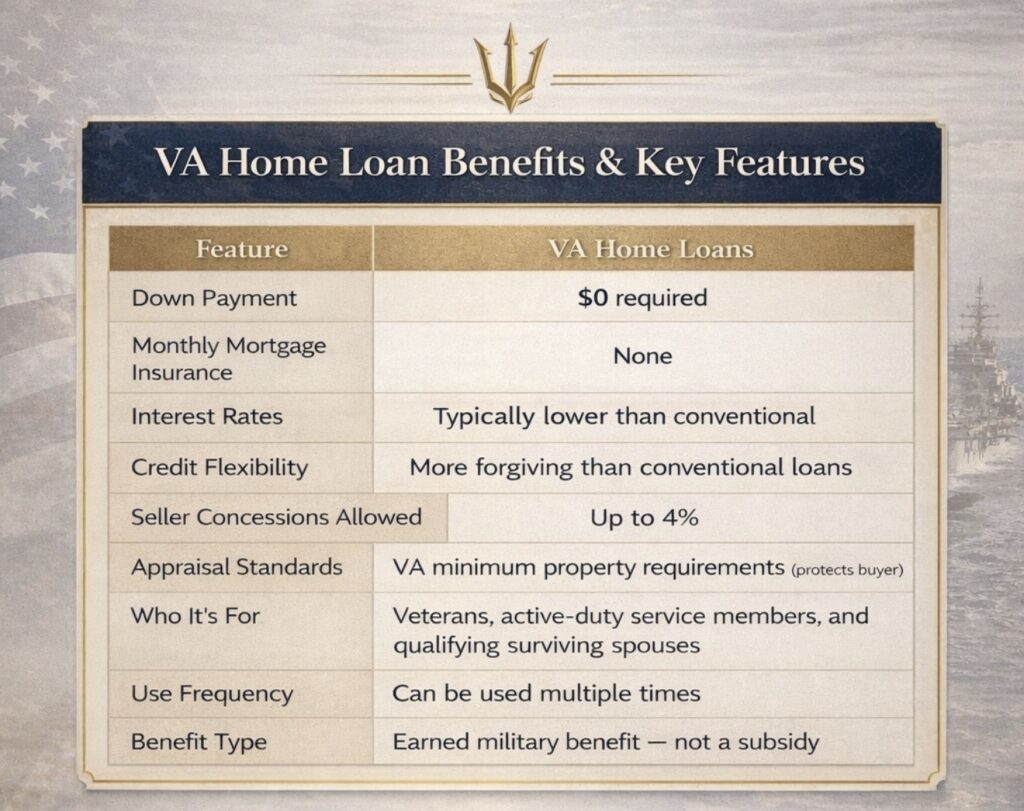
VA home loans were established in 1944 as part of the GI Bill, created to help returning service members achieve stable homeownership after World War II. Today, the program continues to serve eligible veterans, active-duty service members, and qualifying surviving spouses, providing access to one of the most powerful mortgage products available.

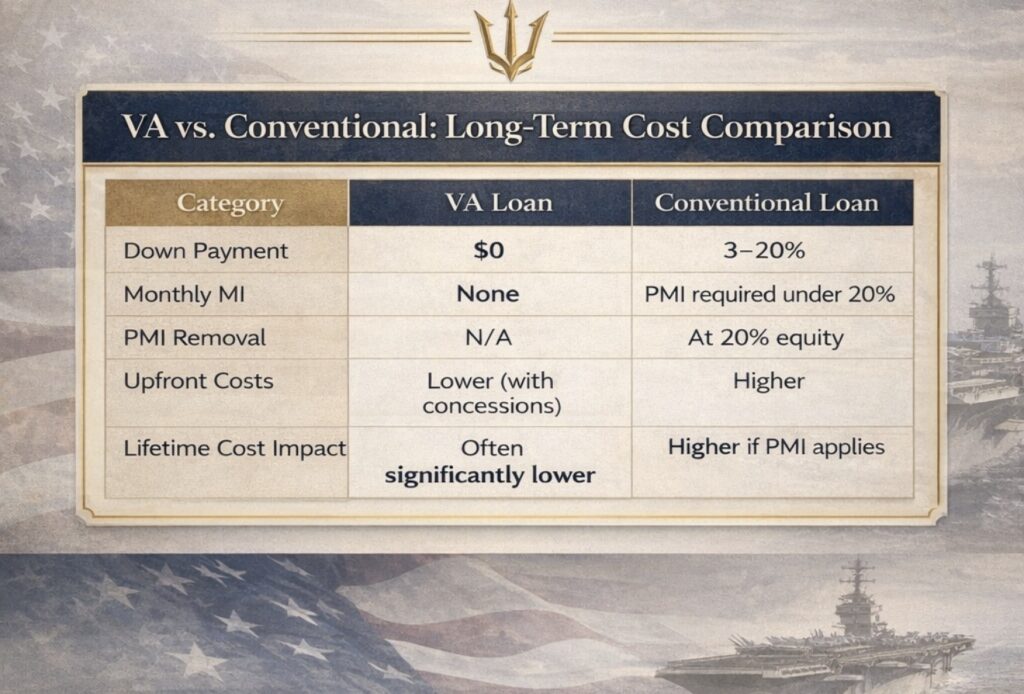
VA loans are not a giveaway … they are earned benefits, designed to recognize the sacrifices made by those who serve. With features like no required down payment, no monthly mortgage insurance, competitive interest rates, and flexible qualifying standards, VA loans reduce long-term housing costs while preserving financial stability. When structured properly, they offer unmatched leverage and purchasing power in competitive markets.

Because this benefit is earned – not given – it deserves to be handled with care, precision, and respect. Strategic structuring ensures the loan honors the intent of the program while positioning veterans and their families for long-term success as homeowners.

Understanding Your VA Benefits

Screenshot
Screenshot

Open Letter From The CEO

VA financing holds particular significance for us. In a small but meaningful way, it allows us to give back to those who have served — by ensuring earned benefits are handled with care, clarity, and intention. We take that responsibility seriously.

These benefits are earned.
Our role is to ensure they are applied strategically, efficiently, and with the respect they deserve.

VA loans aren’t just a product to us.
They’re personal.

In a quiet but meaningful way, our work becomes part of your return home — not the parade, not the uniform, but the after.

We’re not selling you anything.
We’re standing at the doorway back to normal life and saying, “Here. This way.”

This isn’t about volume.
It isn’t about commissions.
It isn’t about closing fast and moving on.

You were trained to leave home — to operate in chaos, to carry weight most people never will. And when you return, the world often expects you to figure it out quietly. Alone.

So a mortgage, in that context, isn’t paperwork.
It’s stability.
It’s continuity.
It’s a path back into a life that feels safe enough to exhale.

To us, veterans aren’t files, rates, or loan types.
They are the living echo of sacrifice — those who walked through fire and came back carrying more than most will ever understand.

When we picture you roaring in the halls of Valhalla, we are not romanticizing war.
We are honoring endurance.
Courage.
Brotherhood.
The cost of standing in the gap so others never have to.

Helping you secure a home isn’t transactional.
It’s almost ceremonial.

A home becomes a shield set down.
A place to rest the armor.
Proof that what you gave was not swallowed by silence.

We aren’t selling you a future.
We’re helping you reclaim a present that feels solid enough to stand on.

Thank you for your service, Johennys Leiva

VA Loans FAQs

Eligibility and Use

Yes. VA loan benefits are reusable. As long as you have remaining entitlement—or you restore entitlement after selling or refinancing a previous VA-financed home—you may use your VA benefit again. There is no lifetime limit on the number of times the benefit can be used.

VA loan eligibility is available to:
🔱 Veterans who meet minimum service requirements
🔱 Active-duty service members
🔱 National Guard or Reserve members (with sufficient service time)
🔱 Certain surviving spouses

Costs & Payments

Yes—qualified VA borrowers can purchase with 0% down. This applies up to the VA county loan limit when full entitlement is available. In some cases (such as higher-priced homes or partial entitlement), a down payment may be required, but many VA buyers purchase with no money down.

The VA funding fee is a one-time fee that helps keep the VA loan program self-sustaining.
It can be:
🔱 Financed into the loan, or
🔱 Paid upfront at closing The funding fee is waived entirely for:
🔱 Veterans receiving VA disability compensation
🔱 Veterans eligible for disability compensation
🔱 Certain surviving spouses If you qualify for an exemption, the fee does not apply—period.

No. VA loans do not have monthly mortgage insurance, regardless of down payment amount.
This is one of the most significant long-term cost advantages of VA financing compared to conventional loans with less than 20% down

Property & Process

VA loans can be used for primary residences that meet VA guidelines, including:
• Single-family homes
• Condos approved by the VA
• Townhomes
• Multi-unit properties (up to 4 units), as long as the veteran occupies one unit
• New construction (with proper approvals)
• Manufactured homes (with additional requirements) The key requirement is occupancy—VA financing is designed to support homeownership, not investment-only purchases.

The VA appraisal serves two purposes:
1. To confirm the home’s market value, and
2. To ensure the property meets VA Minimum Property Requirements (MPRs) These standards focus on:
🔱 Safety
🔱 Structural soundness
🔱 Habitability It’s not a cosmetic inspection. The goal is to make sure the home is safe, livable, and worth the price being paid—not to nitpick minor issues.

No. When structured properly, VA loans close just as efficiently as conventional loans. Delays typically come from:
🔱 Incomplete documentation
🔱 Poor upfront planning
🔱 Lenders unfamiliar with VA guidelines With proactive underwriting and clear communication, VA transactions move smoothly and predictably—often on the same timelines as other loan types.

Flexibility & Reality

Yes. VA loans are far more forgiving than many other loan programs. The VA itself does not set a minimum credit score. Instead, lenders look at the full financial picture, including:
🔱 Payment history
🔱 Income stability
🔱 Debt obligations
🔱 Residual income (what you have left after expenses) Past challenges don’t automatically disqualify you. What matters most is where you are now and whether the loan structure is sustainable moving forward.

Yes. VA financing offers powerful refinance options, including:
🔱 VA IRRRL (Interest Rate Reduction Refinance Loan)
A streamlined refinance designed to lower your rate or payment with minimal documentation.
🔱 VA Cash-Out Refinance
Allows eligible borrowers to access home equity for things like debt consolidation, home improvements, or major life expenses. Both options are designed to prioritize long-term affordability, not short-term gain.

Occupancy & Living Requirements

Yes. VA loans are intended for primary residences. You’re required to personally occupy the home as your main residence. VA financing is not designed for vacation homes or purely investment properties at the time of purchase. That said, life happens – and the VA allows flexibility once the occupancy requirement has been met.

Typically, you must occupy the home within 60 days of closing. There are exceptions for certain circumstances, such as:
🔱 Active-duty deployment
🔱 PCS orders
🔱 Construction or renovations delaying move-in In those cases, intent to occupy is still required, and we help document the situation properly so everything stays compliant.

Yes — up to four units may qualify. As long as you live in one of the units as your primary residence, VA financing can be used to purchase a duplex, triplex, or fourplex. This can be a powerful way to:
🔱 Offset housing costs with rental income
🔱 Build long-term stability
🔱 Transition gradually into real estate ownership while remaining compliant

Appraisals, Repairs & VA Standards

VA Minimum Property Requirements (MPRs) are basic safety, livability, and structural standards — not cosmetic guidelines. They exist to ensure the home is:
🔱 Safe
🔱Sanitary
🔱Structurally sound MPRs focus on essentials like:
🔱Working utilities (water, electricity, heat)
🔱Sound roof and foundation
🔱No health or safety hazards
🔱Proper access and ingress/egress They are not about perfection or upgrades – they’re about protecting the veteran from unsafe living conditions.

If the VA appraisal identifies required repairs:
🔱The repairs must be completed before closing, or
🔱The lender must verify completion through a re-inspection Repairs are typically limited to items tied to safety, habitability, or structural integrity — not cosmetic issues. We coordinate closely with all parties to keep repairs clear, documented, and moving forward without unnecessary delays.

In most cases, the seller pays for VA-required repairs. However, depending on the contract, repairs may also be handled through:
🔱Seller credits
🔱Negotiated concessions
🔱Repair completion prior to closing Veterans are not allowed to pay for repairs themselves in most VA transactions, as the program is designed to protect them from financial pressure.

Yes. VA appraisals can be challenged through a Reconsideration of Value (ROV). If the value comes in low or appears unsupported:
🔱 Additional comparable sales can be submitted
🔱 Errors or omissions can be addressed
🔱 The VA may revise the value if justified This process is structured, formal, and evidence-based — and we guide it strategically when needed.