
Strategic mortgage planning for residential and first-time buyer loans across South Florida.
FHA loans are government-backed mortgages designed to make homeownership more accessible, particularly for first-time buyers, moderate-income borrowers, and those with limited down payment funds or less-than-perfect credit. Insured by the Federal Housing Administration, FHA loans allow for more flexible qualifying standards than conventional financing, including lower minimum credit scores and down payments as low as 3.5%.
Because FHA loans carry federal mortgage insurance, lenders are able to offer more forgiving approval criteria. This insurance comes in the form of MIP (Mortgage Insurance Premium), which protects the lender in the event of default and is required on all FHA loans regardless of down payment size. While MIP adds to the monthly payment, FHA loans can be a powerful tool when used strategically – especially for buyers prioritizing accessibility, cash preservation, or rebuilding credit while entering the housing market.
That said, FHA is not the only low down payment option available to first-time homebuyers. Many buyers may also qualify for conventional low-down-payment programs, such as Fannie Mae’s HomeReady® or Freddie Mac’s Home Possible®, which can offer down payments as low as 3%, reduced mortgage insurance, and more favorable long-term costs for eligible borrowers.
HomeReady® is a conventional loan program designed for first-time and moderate-income homebuyers who want the benefits of low down payment financing without the long-term costs of FHA mortgage insurance. Backed by Fannie Mae, HomeReady allows qualified buyers to purchase a primary residence with as little as 3% down, while offering reduced private mortgage insurance and more favorable long-term economics.
Unlike FHA loans, HomeReady does not require upfront mortgage insurance, and monthly PMI can be lower and cancellable once sufficient equity is reached. For borrowers with stable income, strong credit, or long-term ownership plans, this can result in significantly lower lifetime loan costs compared to FHA – even with a smaller down payment.
HomeReady eligibility is based in part on Area Median Income (AMI) limits tied to the property’s location, not just the borrower’s profession or background. Many buyers who assume they must use FHA are surprised to discover they qualify for HomeReady – especially in urban and high-cost markets where AMI thresholds are higher than expected.
When evaluated strategically, HomeReady can be an ideal solution for buyers who want:
• Lower down payment requirements
• Reduced and cancellable mortgage insurance
• Conventional underwriting flexibility
• Cleaner long-term affordability
Eligibility for these conventional programs is often tied to Area Median Income (AMI) limits based on property location. In many cases, buyers are surprised to learn they qualify for conventional financing – even when FHA was initially assumed to be the only path. Evaluating both options side-by-side ensures the loan structure aligns with the borrower’s income, credit profile, long-term goals, and overall cost of ownership.
Choosing between FHA and HomeReady isn’t about which program is easier – it’s about which structure best supports the borrower’s financial position today and equity goals tomorrow.
Not sure which low-down payment loan fits you best?
FHA isn’t the default – it’s one of several tools.
The right choice depends on income limits, property location, long-term costs, and how you plan to build equity.
What we’ll evaluate together:
• FHA vs HomeReady vs standard conventional
• Area Median Income (AMI) eligibility by address
• Monthly payment and mortgage insurance differences
• Long-term cost impact over time
Understanding Your Low-Down Payment Options
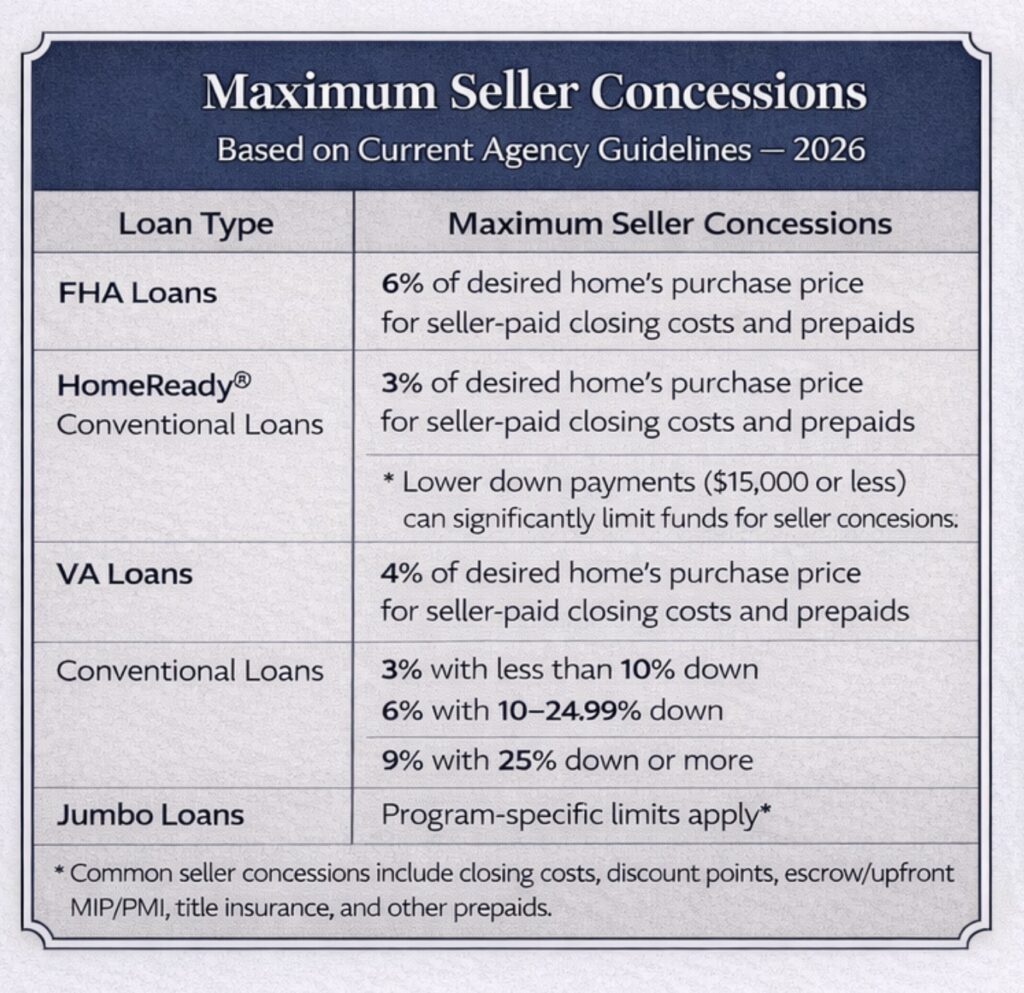
Seller Concessions by Loan Program
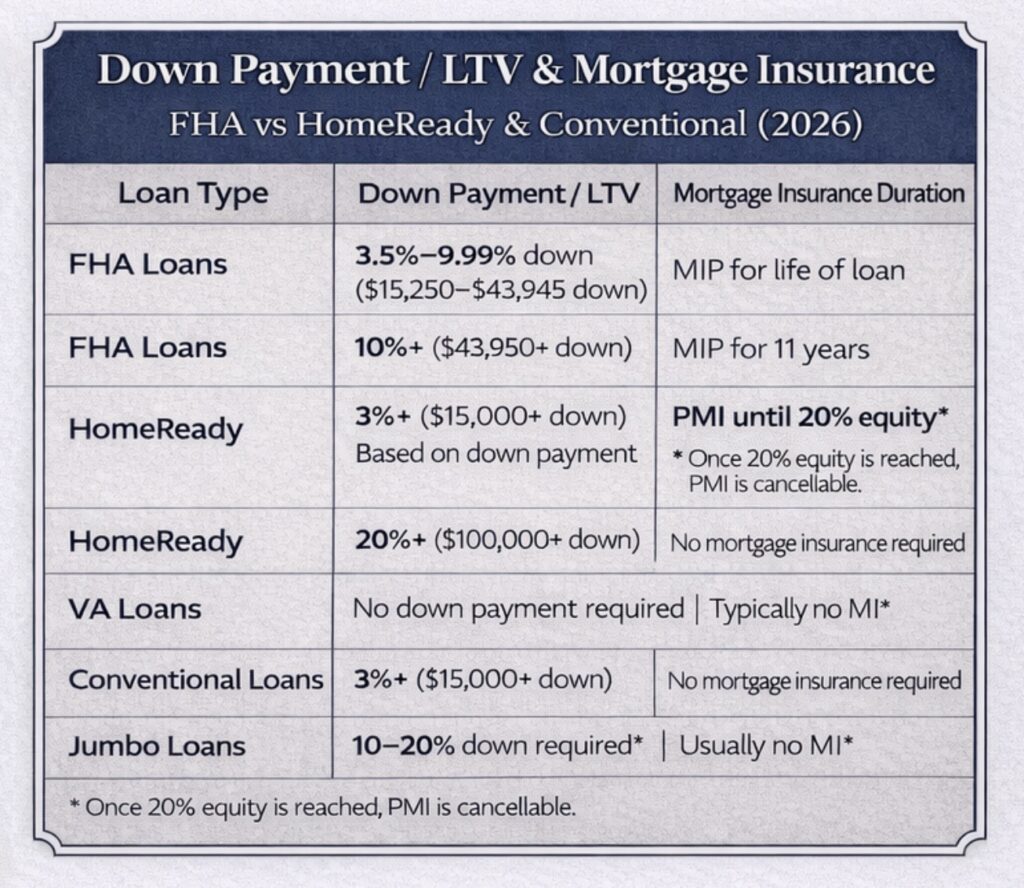
Down Payment, LTV & Mortgage Insurance Comparison
FHA Q&A’s
Q: Why do FHA loans require mortgage insurance for the life of the loan?
FHA loans are insured by the federal government to reduce lender risk and expand access to homeownership. Because of that structure, FHA requires Mortgage Insurance Premium (MIP) to remain in place for the life of the loan when the down payment is less than 10%. This insurance protects the program – not the borrower – which is why long-term cost analysis is critical when choosing FHA versus conventional alternatives.
Q: Can FHA mortgage insurance ever be removed?
Yes – but only under specific conditions.
If a borrower puts 10% or more down, FHA mortgage insurance is removed after 11 years. For down payments below 10%, MIP remains for the full loan term. Many borrowers later refinance out of FHA into a conventional loan once equity and credit allow, which is why FHA should be viewed as a strategic entry point, not always a permanent solution.
Q: Is FHA the best option for first-time homebuyers?
FHA can be an excellent option for buyers with lower credit scores, limited down payment funds, or higher debt ratios – but it is not always the most cost-effective long-term loan. Programs like HomeReady® or standard conventional financing may offer lower lifetime costs, cancellable mortgage insurance, and better equity outcomes. The best choice depends on income, credit profile, property location, and long-term ownership goals.
HomeReady® Loan FAQs
Q: How is HomeReady different from FHA if both allow low down payments?
While both programs allow low down payments, HomeReady is a conventional loan, not a government-insured program. That means mortgage insurance is private, typically lower, and cancellable once sufficient equity is reached. FHA mortgage insurance, by contrast, is often required for the life of the loan. For borrowers with stable income and long-term ownership plans, HomeReady can result in significantly lower total loan costs over time.
Q: Who qualifies for HomeReady?
HomeReady eligibility is based in part on Area Median Income (AMI) limits tied to the property’s location. Many buyers who assume they don’t qualify are surprised to learn they do – especially in higher-cost or urban markets where AMI thresholds are higher. Credit profile, household income, and occupancy type all matter, which is why eligibility should be reviewed by address, not guessed.
Q: Can mortgage insurance be removed on a HomeReady loan?
Yes. HomeReady mortgage insurance follows standard conventional rules and can be removed once 20% equity is reached, either through appreciation or principal reduction. This flexibility is one of the program’s biggest advantages and a key reason HomeReady is often a better long-term alternative to FHA for qualified buyers.
🔱WHO THIS IS FOR
- First-time homebuyers
- Repeat buyers purchasing a primary residence
- Buyers with limited down payment funds
- Buyers using gift funds or seller concessions
- Buyers planning future refinancing or equity use
⸻
🔱 FHA vs CONVENTIONAL FOR FIRST-TIME BUYERS
FHA Loans – What They’re Really For
FHA loans were created in the 1930s to expand homeownership and stabilize the housing market by insuring lenders against loss. The goal wasn’t just low-down payments – it was accessibility, long-term sustainability, and flexibility.
• Minimum 3.5% down
• More forgiving credit guidelines
• Higher allowable DTI
• Mortgage insurance (MIP) applies, but:
• FHA allows higher refinance LTVs later
• Often easier to restructure when rates fall
• FHA is not only for low-income buyers
⸻
🔱 Strategic angle:
FHA can be an excellent long-term tool when rates are expected to come down because it allows refinances above 80% LTV that conventional does not.
⸻
🔱FHA REHABILITATION LOANS (underrated power move)
FHA 203(k) – Buying + Renovating
Explain simply:
• Purchase + renovation in one loan
• Ideal for:
• Older homes
• Cosmetic or structural improvements
• Buyers who want equity upside
• Especially powerful in South Florida neighborhoods
⸻