
Jumbo & Complex Income Loans are designed for high-income, self-employed, and non-traditional borrowers whose loan amounts exceed standard conforming limits. A jumbo loan is any mortgage that goes above the conventional loan limits set by Fannie Mae and Freddie Mac, requiring a more strategic underwriting approach.
Because jumbo loans fall outside traditional agency guidelines, they are underwritten differently – often allowing greater flexibility in income structure, assets, and portfolio-based qualification. Unlike conventional loans, jumbo financing typically does not require PMI or MIP, even with lower down payments. Instead of mortgage insurance, risk is managed through stronger credit profiles, verified reserves, and overall financial positioning.
When structured correctly, jumbo loans can offer competitive pricing, cleaner long-term economics, and significantly more flexibility for high-income, self-employed, and asset-based borrowers across South Florida.
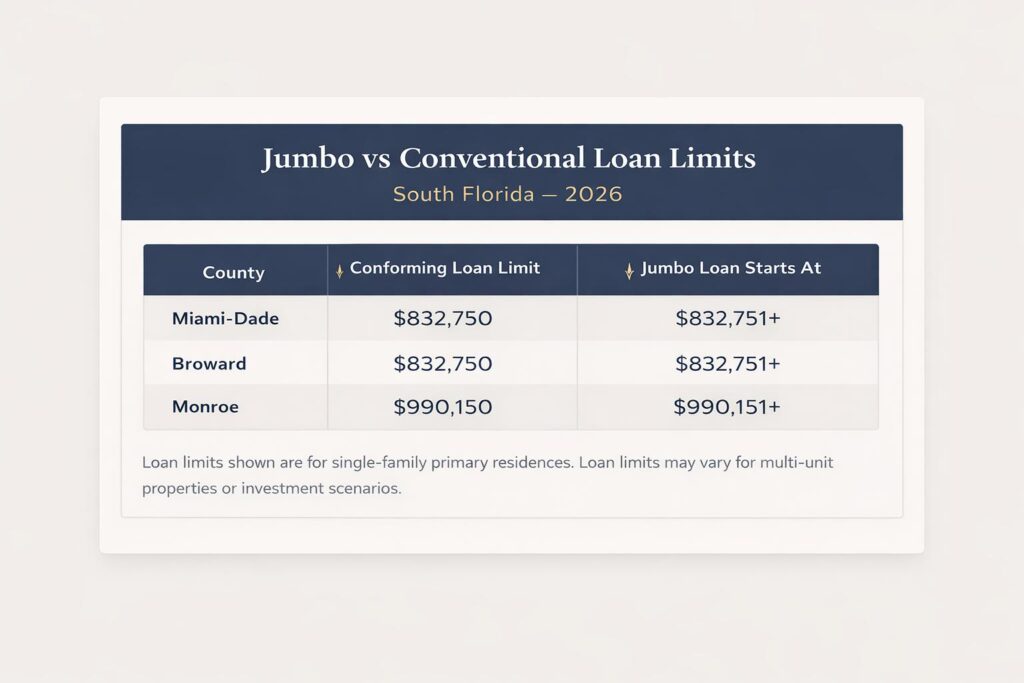
In Miami-Dade and Broward counties, the 2026 conforming loan limit for a single-family home is $832,750. In Monroe County, the limit is higher—up to $990,150 – before a mortgage is classified as a jumbo loan. Any loan amount exceeding these limits is considered non-conforming and requires jumbo financing, regardless of down payment size. Loan limits shown are for single-family primary residences. Multi-unit, second homes, and investment properties may have different thresholds.
Jumbo vs Conventional: Key Differences
If your income is complex, your approach should be too
JUMBO FAQ’s:
Q: Do jumbo loans always have higher rates?
Not necessarily. While jumbo loans were historically priced higher than conventional loans, that isn’t always the case today. Jumbo rates are risk-based and depend heavily on borrower strength — including credit profile, asset reserves, loan-to-value ratio, and overall financial positioning.
For well-qualified borrowers, jumbo loans can be competitively priced and in some cases comparable to — or even lower than — conventional rates. The key difference is that jumbo pricing rewards preparation and structure, not just income.
Q: Can you put 10% down?
Yes — in many cases, 10% down is possible on a jumbo loan, depending on the lender, loan amount, and borrower profile.
Because jumbo loans do not follow agency guidelines, down payment requirements are more flexible and are evaluated alongside credit strength, liquidity, income stability, and reserves. A strong overall financial profile can often offset a lower down payment, making jumbo financing accessible without tying up excessive cash.
Q: Are Jumbos harder to qualify for?
Jumbo loans aren’t necessarily harder — they’re simply evaluated differently.
Instead of rigid templates, jumbo underwriting takes a more holistic view of a borrower’s financial picture. This includes income structure, asset depth, credit quality, and long-term sustainability. For high-income, self-employed, or asset-based borrowers, this flexibility can actually make jumbo loans more attainable than conventional options.
The process rewards planning, documentation strategy, and proper positioning — which is why a strategic approach matters.
🔱WHO THIS IS FOR
• Self-employed borrowers
• Business owners & partners
• High-W2 earners with variable bonuses
• Asset-heavy / liquidity-based borrowers
• Multiple properties or layered income streams
⸻
🔱 WHAT MAKES JUMBO & COMPLEX DIFFERENT
• Income is scrutinized differently
• Cash flow > gross income
• Documentation strategy matters
• Structure affects approval more than rate
⸻
🔱 INCOME TYPES
• W-2 with bonuses / RSUs
• Self-employed (Schedule C, K-1, 1120S, 1065)
• Asset-based qualification
• Rental income & portfolios
• Multiple income sources
⸻
🔱 OUR STRATEGIC APPROACH
• Income analysis before submission
• Pre-underwriting mindset
• Documentation sequencing
• Structure first, pricing second
• Anticipating lender friction
⸻
🔱 COMMON MISTAKES
• Submitting income too early
• Choosing the wrong jumbo channel
• Over-documenting (yes, that’s a thing)
• Triggering unnecessary conditions